Strategy Development Blog #5 - Big tech, is it a bubble? If yes, when will it pop?
The main learning of the week.
For the last blog of this series, I decided to choose a different structure. The reading of this week called: "2018 Corporate Longevity Forecast: Creative Destruction is Accelerating (By Anthony, Viguerie, Schwartz, and Landeghem)" did create the most waves in my brain. Although it expanded some of my insights and displays some extremely interesting data, I feel it is also missing some nuances. In this blog, I will follow up and nuance this very interesting article.
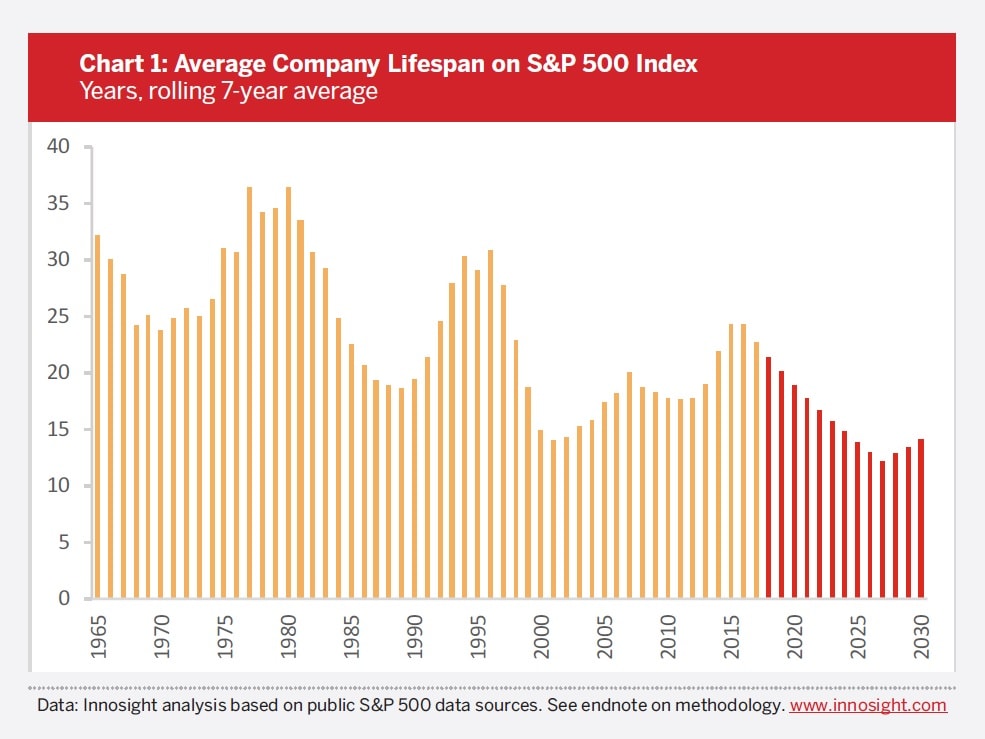
The main statement.
The image showed above (from the article) perfectly displays a very interesting prognosis. This is, where the lifespan of an average company in the S&P 500 will reduce and keep on reducing until around 2026. This is clearly a prognosis and the historical data displays that the lines will clearly not go this linearly down as shown in this prognosis. This is also not the main notable part of the graph, which is the curve it makes after 2026.
Looking at the graph and earlier history, there are some obvious timestamps in history which change the direction of the line drastically. The most recent one clearly being the worldwide financial crisis. This had a medium, but the obvious impact on the slope of the graph. It is forming a small hole in an upgoing trend. This is as expected since the stock market crashed and multiple companies lost a lot of their market cap.
Nonetheless, the big change just before that, around the year 2000 is even more interesting. At that part, the shift in slope is way bigger. As probably all of you readers can remember this is the point when the dot com bubble popped. In the years before that, digital firms suddenly rose disproportionally in market cap. Eventually, their market cap turned out to be around 80 times their earnings. (2)
The dot com bubble was one of an enormous impact; markets crashed enormously, investors lost trust in the market and especially telecom and online companies had to take high hits. The winners of yesterday became the losers of tomorrow. This resulted in a huge in companies which existed in the S&P 500 and made investors move to more slow-moving stocks. (3)
A different bubble.
This time it is different. Where the big tech-companies as Alphabet (Google) with a PE ratio of 29.5 (4) and Facebook with 28.7 (5) as the big leaders seem to have turned into complete normal stocks, Amazon already starts to tell a different story with a PE Ratio of 80.43 (6). Nonetheless, this is completely beaten by Netflix, for example, which has a whopping PE ratio of 132.34 (7). With big tech-firms continuously going public, with even no profit, which is only burning through cash (examples are Uber, Lyft, Snapchat, and Spotify) we might end up reaching another bubble.
This bubble will not display itself in insane PE values, because companies might not even reach the profiting point. This might result in another bubble pop. Currently, it is straight our guessing if we are currently in a clear tech-bubble, and most importantly, if there is a bubble, how hard will it pop? And when? Will the impact on lifetime in the S&P 500 change as dramatically as during the dot com bubble? (8)
Important is to notice that over and undervaluation is a factor with an enormous impact on the positioning on the position in the S&P 500. This does NOT mean that a relatively new tech firm has a stronger position inside the market then the more 'classic' company it has kicked out of this list. Recently in December 2018 the enormous drop in the stock market even might have had a big impact in the positioning of companies, which has to be discovered in graphs which will be published later on. (9).
For more additional thoughts or discussions, you can always email me at gsmeden@andrew.cmu.edu.
References:
(1) - https://www.innosight.com/insight/creative-destruction/
(2) - https://www.mckinsey.com/business-functions/strategy-and-corporate-finance/our-insights/the-tech-bubble-puzzle
(3) - https://hbr.org/2001/05/whos-to-blame-for-the-bubble
(4) - https://finance.yahoo.com/quote/GOOG/
(5) - https://finance.yahoo.com/quote/FB/

No comments:
Post a Comment
Note: Only a member of this blog may post a comment.